





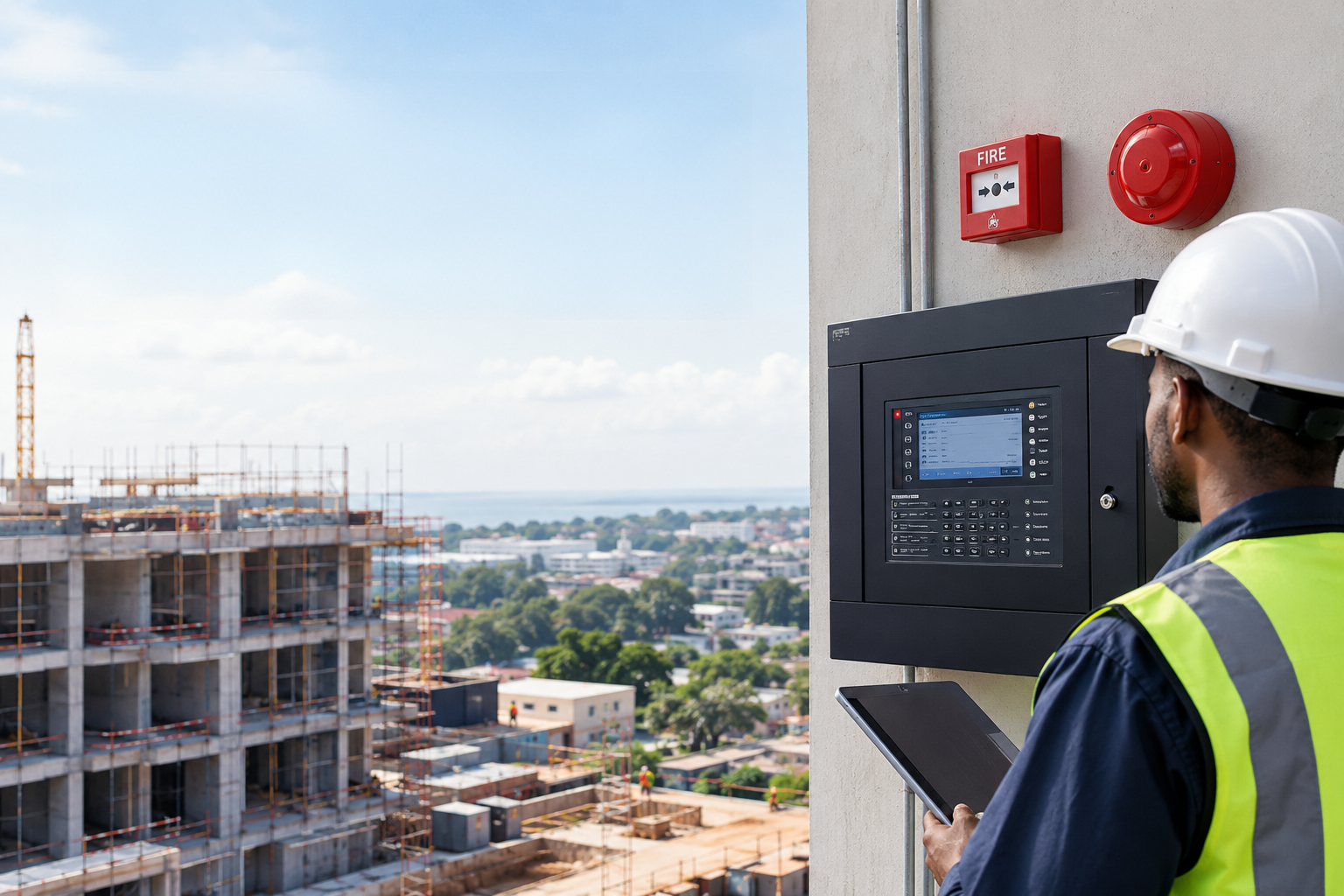
 Across Africa, demand for fire alarm systems keeps growing with new infrastructure — and Chinese-aid and Chinese-contracted works add their own requirements for certification and documentation. But for the contractor, developer, or procurement lead, the practical question is the same: should this project use a Conventional or an Addressable system? There is no one-size-fits-all answer — the right choice comes from weighing several factors together. This guide walks through how the two architectures differ, which factors drive the decision, how the trade-offs look for common project types, and what African and Chinese-aid projects add on top.
Conventional vs. Addressable: the differences that matter for selection
Both system types detect fire, notify alarms, and integrate equipment — but their architectures differ, and each difference shifts the trade-off for a particular project.
Wiring topology — zone vs. loop
Conventional systems divide the building into zones, each on a dedicated circuit back to the panel; the panel shows which zone is in alarm. That keeps design and installation simple, which is why Conventional remains common in smaller footprints with fewer devices. Addressable systems use loop wiring (SLC): every detector, call point, and module has a unique address on a shared loop, so one cable daisy-chains many points. Once device counts or floor area grow, loop wiring tends to cut cable pulls and termination labor noticeably.
Direction: the smaller and simpler the building, the more Conventional’s simplicity tends to pay off; the larger and more spread out, the more loop wiring helps.
Alarm & fault identification — zone vs. exact device
A conventional panel reports the zone in alarm but not the specific detector. Addressable systems pinpoint the exact device and its location. Where staff respond to alarms themselves and verification speed matters — hospitals, commercial complexes, industrial sites — knowing exactly where to walk saves time during the event and makes day-to-day maintenance easier.
Direction: the more it matters to know precisely which device triggered an alarm, the more Addressable’s exact location helps.
Scale & expandability
Conventional scales by adding zones and circuits as device count grows — straightforward, but each new zone means more home-run cabling back to the panel. Addressable carries many addressed devices on one loop, centrally managed, so added devices are absorbed with less rewiring. For a building whose scope is fixed and modest, that flexibility may never be needed; for dense or evolving sites, it usually earns its keep.
Direction: a fixed small building often finds Conventional sufficient; high device density or likely expansion gives Addressable an edge.
Note: the three differences above point in directions, not verdicts. Building scale, device count, locating needs, expansion plans, integration requirements, budget, and local regulations all weigh into the final choice together — no single factor decides the architecture on its own. The next two sections show how these factors combine.
Weighing the factors: how the decision actually comes together
None of the factors below decides alone — real projects balance them against each other. A small building that must integrate with a BMS may still lean Addressable; a large warehouse with a tight budget and no expansion plans may stay Conventional. Use the five factors to frame the trade-off:
- Building scale & device count — the biggest cost lever. Loop wiring generally saves cable and labor once device counts and floor area grow past a modest level; below that, zone wiring is usually the cheaper route.
- Need for precise location — if your own staff respond to alarms, exact device location shortens response and eases maintenance; if a zone alert is enough for how the building operates, it carries less weight.
- Future expansion or retrofit — zones are cheap to add on paper but each means new home-run cabling; loops absorb added devices more easily. Buildings with phased development plans should weight this factor heavily.
- Upfront budget vs. lifecycle cost — Conventional usually wins on first cost. Addressable can narrow the gap over time through faster fault-finding, fewer inspection hours, and lower false-alarm costs, especially where a false alarm is expensive or disruptive.
- System integration — interfaces to BMS, emergency lighting, or fire doors are typically easier to configure on an addressable loop; standalone alarm-only buildings are less affected.
Note: these factors are judged as a whole, not one by one. The same device count can point either way depending on layout, budget headroom, and local rules — treat the outcome as a balanced judgment rather than a lookup table.
As a general tendency: small, simple, and fixed leans Conventional; large, dense, or still developing leans Addressable — with the trade-offs above deciding everything in between.
A quick check by project scenario
Use the table as a quick check, then read the notes below it.
| Project scenario | What to consider | Typical direction |
| Small office, retail unit, or similar small building | Limited device count, simple layout, no major expansion planned | Often Conventional |
| Factory, warehouse, or similar single-purpose building | Cost-sensitive, open layouts, moderate device count | Often Conventional, depending on device count and monitoring needs |
| Hotel, hospital, mall, or multi-story complex | Many devices across floors; fast, exact alarm location matters | Often Addressable |
| Building expected to expand or undergo phased renovation | More zones or devices later; re-cabling zones is costly | Addressable often worth considering |
| Needs integration with BMS or emergency lighting | Interfaces and ongoing configuration changes | Addressable usually the more flexible fit |
| Mid-size project (roughly 100–500 devices) | Budget vs. long-term O&M trade-off | Case by case — mixed designs are also common |
Note: this table is a preliminary reference, not a substitute for design. The same scenario can end up either way once building use, device count, drawings, host-country regulations, and the certification a tender requires are factored in — confirm against the actual project conditions.
A word on the grey zone: for mid-size projects the honest answer is often “either can work.” Some designs put an addressable panel at the core with conventional zones on extensions; others stay fully conventional and accept more inspection hours. Comparing total cost over a 5-year horizon — equipment, cabling labor, commissioning, and ongoing maintenance — is a more reliable guide than the panel price alone.
Extra factors for African projects
Africa is the backdrop, not a separate topic — these constraints sit on top of the judgment above.
- Certification & standards — Local projects follow host-country regulations; some require recognized product certification. Chinese-aid / Chinese-contracted works may require CCC or equivalent, and may follow GB series or GB plus local rules. Verify the required scope from the tender and design specs before selecting.
- Environmental adaptability — High temperatures, dust/sand, and unstable power are common in parts of Africa. Confirm operating-temperature range, choose suitable detection methods for dusty sites, and plan power supply / backup for unstable grids. A system that fails in the environment costs more than a pricier one that survives.
- Supply chain & technical support — Overseas projects live or die on documentation and communication. English-language specs, test reports, and responsive support affect procurement, approval, installation, and commissioning efficiency.
Additional requirements for Chinese-aid / Chinese-contracted projects
Treat this as one special scenario, not a separate essay. These projects carry defined technical documentation, product-qualification, and procurement specs. Fire alarm products may need CCC certification or equivalent, with files submitted for technical review and approval. Project teams should map the required products and certification scope from the tender, design, and approval requirements — especially the Chinese general contractor managing submittals.
Where TYEE fits in
If TYEE is on your shortlist, the points below simply map its capabilities to the needs discussed above — any manufacturer you consider can be checked against the same list.
- Product range — addressable commercial fire alarm systems (smoke and heat detectors, manual call points, sounder beacons, input/output modules, control panels) plus standalone detectors. Where a project also calls for evacuation lighting, TYEE’s emergency lighting systems can be specified alongside the fire alarm.
- Chinese-aid / contracted works — fire alarm and emergency products comply with Chinese GB standards (TYEE is a drafting unit of GB 17945 and GB 51309); CCC/3C certification and the corresponding qualification files can be provided for technical review where required.
- Track record — manufacturing since 1992, with project references across Africa and other markets.
If it would help to talk it through: send your building type, approximate device count, and technical requirements, and the TYEE team can suggest a configuration based on your actual project conditions.
FAQ
Q: Conventional or Addressable for a small building?
A: For most small buildings with a limited device count, Conventional does the job — it covers basic detection and alarm at a lower installed cost. Addressable starts to make sense when device numbers grow, the layout spreads out, or you need to know exactly which device triggered an alarm.
Q: What certification should I check for an Africa project?
A: It depends on the country and the project type. Host-country regulations come first; some tenders also call for recognized product certification. For Chinese-aid or Chinese-contracted works, CCC or equivalent — sometimes GB-based requirements — are common. The tender and design specs are the definitive list.
Q: Can I mix the two systems in one project?
A: Often, yes. Mid-size projects sometimes use an addressable panel at the core with conventional zones on extensions, or mix branches by building section. Whether it pays off depends on layout and cabling distance, so it’s worth pricing it both ways.
Q: What project information is needed for system selection?
A: At minimum: building type and size, approximate device count, number of floors or zones, expansion plans, and any integration requirements (BMS, emergency lighting, fire doors). Site conditions matter too — ambient temperature, dust, and power stability all affect what configuration makes sense.