






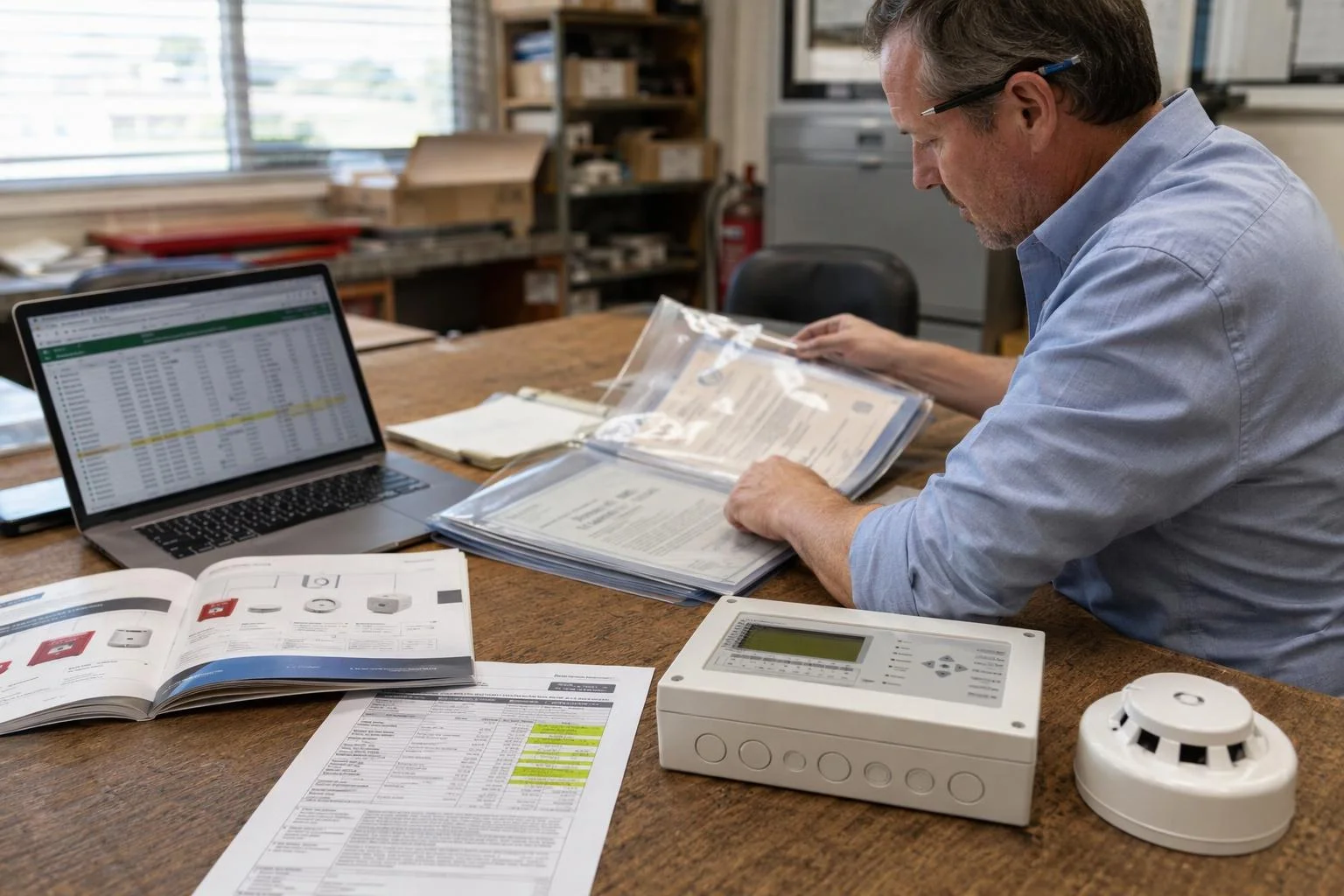
A distributor preparing a first fire alarm order from China usually starts with a spreadsheet. A few suppliers, catalogues that read much the same, product photos that look like they came from the same shoot, and quotes bunched closely enough that the cheapest column starts to look like the answer. On paper, everything looks interchangeable.
It rarely is. What decides whether a first order works isn’t in the price column. It’s whether the UL documents behind the quote are real and cover the exact models being bought, whether the sample will match the bulk goods, whether the factory can show its production and testing records, and whether anyone still answers your questions once payment has cleared.
That is why we think of a first order as buying a verification process, not a product at a price. The sequence matters: check the UL documents, test a sample, prepare for factory vetting, settle the commercial questions, then pay. To be clear about what follows: the distributor in this article is a representative example, not a specific real distributor and not a real order we handled. The situation is typical; the details are illustrative. For background on the wider field of fire safety manufacturers in China, the pillar page is a useful starting point.
The Easiest Mistake on a First Order: Comparing Price Only
The cheapest quote isn’t a verdict on the supplier — it’s a number attached to a claim. First-time buyers line up quotes because it’s the one input that arrives in a format you can compare, and the lowest column starts to feel like a decision. What that comparison skips is everything that decides whether the order works.
Three things fall out of view the moment price becomes the sorting tool.
Whether the documents are real. A quote can carry a UL reference that belongs to a different model, a different product family, or a file that doesn’t cover the item being priced. The number looks the same either way.
Whether the sample matches the bulk goods. Samples are often built and checked with more care than a production run. A buyer who never tests the sample, and never records what it looked like, has no baseline to compare the shipment against.
Whether anyone answers after payment. Before payment, replies come quickly. The question is what happens with a fault report, a missing spare part, or a labelling problem months later. Price comparison cannot see this at all.
Those three questions are what a first order is really testing, and the lowest number says nothing about any of them. The supplier landscape is wide and uneven — some companies are genuine manufacturers with their own lines, others assemble or trade — which is why the fire safety manufacturers in China overview is worth reading before the spreadsheet gets too comfortable.
Finish the checklist first. Then the price conversation has something to stand on.
How to Check UL Documents: What to Look At and What to Ask
Ask the supplier, in writing, for the UL documentation that covers the exact models quoted — then check it against UL’s own records, not against the supplier’s summary of it. This comes first because everything after it, from the sample to the factory visit to the payment, assumes the product you’re discussing is the product that was certified.
What to look at. Start with the model number. Not the product family, not the series name — the exact model on the quote against the exact model on the UL file. Mismatches here are common and often innocent-looking: a family name that covers several variants, a suffix that changes the construction, a model that appears in a catalogue but not in the certification information. Next, confirm the file covers the product type being ordered. A supplier with genuine certification for one category does not automatically hold it for another, and a buyer ordering across automatic fire alarm and emergency lighting should check each category separately. Finally, put the datasheet beside the file. If the datasheet describes features, ratings or configurations that the certification information does not reflect, that gap needs an explanation before anything is paid.
What to ask. Ask the supplier to state, in writing, which file each quoted model sits under. A supplier working from its own certification will answer directly. One working from someone else’s documentation tends to answer around the question.
How to verify it yourself. UL certification information is publicly searchable through UL Product iQ, UL’s online location for certification information, which combines data from the former Online Certification Directory and other UL databases. You can search by company name, model number, category description or UL file number, and review the specific items returned. A free account lets you verify UL certification of products and components. The point is simple: you can check the supplier’s document at the source instead of taking it on trust.
What this check can’t do is guarantee an outcome in your market. It confirms the certification information exists and matches what you’re being sold — which is the question a first order needs answered.
Sample Testing: What to Check When the Sample Arrives
A sample has one job: to show that what was described is what will ship. What follows are buyer checks, not lab results — no test standards, no pass thresholds, just what a distributor can see with the unit on a bench and the datasheet beside it.
Appearance and build. Look at the housing, the seams, the terminals, the finish. Does it feel like a production item or a hand-assembled one-off? Make sure screws, glands and mounting points are all there and fit properly. Small shortcuts in a sample usually point to bigger ones in a bulk run.
Basic function. Power the unit the way it would be powered in service, and confirm the alarm and reset behaviour matches the datasheet. On detection devices, trigger the alarm condition, confirm the indication, then reset and check the device returns cleanly to normal. Do it more than once. A device that only resets reliably on the third try is telling you something.
Fault indication. Create a fault the way the product is designed to report one — pull a detector, break a circuit, cut the supply — and confirm the indication shows and clears correctly. A unit that can’t show a fault clearly will be hard to support in the field.
Labelling and consistency. Compare the label and printed markings on the unit with the datasheet you checked in the previous step. Model number, ratings, marking content: they should agree. Note anything that differs, even slightly, and ask about it in writing.
Record what you see. Photograph the sample, keep the datasheet version you used, and write down the date it arrived and what you found. That record is the reference for the bulk shipment, and it’s the cheapest quality document a distributor will ever produce.
Mismatches caught here are small and fixable. The same mismatches caught after a bulk delivery are neither.
Before the Factory Check: The List to Prepare
A factory visit or remote audit works best when you arrive with a list rather than an impression. Nobody there is trying to trick you, and you’re not trying to catch anyone out. The question is whether the manufacturer can show you, on the day, the things a real production operation keeps anyway.
Documents to request in advance. The business licence and the manufacturer’s own company details, the UL documentation for the models under discussion, the quality management certification, and a catalogue whose model numbers match the documentation. Ask for them before the visit so your time on site goes to verification instead of paperwork.
Questions to have ready. Who actually makes the product — the company you’re talking to, or a third party? Which production steps happen in-house, and which are outsourced? How is incoming material checked, and how are components traced through to finished units? What testing happens on the line, and what records are kept? Who signs off a batch before it ships?
What a real manufacturer should be able to show. Production: the lines where the product is actually made, and the equipment doing the work. Testing: the test area, the instruments, and evidence they’ve been calibrated. Inspection: incoming, in-process and final checks, with records you can pull for a specific batch. Traceability: the ability to link a finished unit back to its materials and forward to the shipment it left in. Under UL’s Follow-Up Services program, manufacturers carrying the UL Mark are subject to on-site surveillance, in which field engineers countercheck that production controls and an effective quality system are maintained — inspection and test, documentation, calibration, material control and records. A factory that lives with that system can show it without rehearsal.
There’s a longer version of this list in our guide on how distributors vet a China manufacturer: what to ask, in what order, and how to read the answers. Read that before the visit; keep this page for why the visit matters.
Lead Time, MOQ and After-Sales: Questions to Settle Before You Pay
These aren’t details you negotiate after the order. They’re part of the verification the first order is buying. Get each one answered in writing before you pay, and leave any open figure visibly open rather than filling it in yourself.
Lead time. What’s the production lead time for the exact quantities quoted, and where does it start counting — order confirmation, deposit, or artwork approval? Does it change on a repeat order? What’s the transit time to your port, and who handles export documentation?
Minimum order quantity. Is the MOQ a per-model figure or a per-order figure? Can mixed models be combined to reach it? What MOQ applies to spare parts and accessories? MOQ varies by product and by supplier, so the number that counts is the one written into your quotation.
Sample cost and timing. Is the sample charged, and is it credited against the bulk order? How long does it take to produce and ship, and who pays the freight?
Warranty terms. How long is the warranty, and from what date? What does it actually cover — manufacturing defects, components, or the full unit? Who decides whether a claim is valid, and is the remedy a replacement, a credit, or a repair?
Spare parts. Which parts are worth stocking as spares, at what ratio, and at what price? Will they still be available after the warranty ends?
After-sales route. Who is the contact after shipment, in which language, and within what response time? Is there a local agent or warehouse, or does everything route back to the factory? What is the process for a fault report — photos, batch numbers, return authorisation?
Get the answers in the quotation or a signed order confirmation, not in a chat thread. The point is not to negotiate hard; it is to know exactly what you have bought.
After the First Order: How the Second Order Is Different
Once the first order has arrived and been checked, the second order stops being a verification exercise. The supplier has been checked. What carries the relationship forward is the record you built along the way.
What to record. Keep the quotation and order confirmation with the agreed lead time, MOQ and warranty terms. Keep the UL documentation for the exact models you bought, and note the date you checked it. Keep the sample photos and observations, plus the datasheet version you compared them against. When the bulk shipment lands, check it against that record — labelling, model numbers, build — and write down any deviation. Keep the after-sales correspondence, including how each issue got resolved. This file is what turns a one-off purchase into a supplier relationship.
When the second order changes character. The second order is a normal purchasing decision when three things hold: the documents still cover the models you’re reordering, the delivered goods matched the sample and the datasheet, and the after-sales questions were answered in practice rather than only on paper. If any of those is still open, the second order is still a verification exercise, and you should treat it as one.
How the relationship works afterwards. A checked supplier can be given more: a forecast, a wider product range, a conversation about custom labelling, a scheduled delivery plan. That’s also when price becomes a fair conversation, because both sides now know what’s being compared. The first order bought information; the second order can spend it.
We’ve seen this pattern often enough to trust it. Buyers who verify first tend to reorder. Buyers who shop on price alone tend to spend the second order fixing the first.
Conclusion: The First Order Buys a Verification Process
The lesson holds on every first order: what you’re buying is a verification process, not the lowest price. The UL documents tell you whether the product is what it claims to be. The sample tells you whether the description matches the goods. The factory check tells you whether the operation behind the goods is real. The commercial questions tell you what happens after the money leaves. Price comes last on the list, not first.
Finish the checklist, then talk about price — and expect that conversation to be shorter, because most of the uncertainty is already gone.
If you’re putting together a first fire alarm order from China and want the paperwork in one place, get in touch and we’ll send a distributor information pack and a UL document checklist. We’re glad to walk a first-time buyer through what to ask before payment.